Short answer: Australian rental property expenses fall into three groups. Loan interest, council rates, land tax, body corporate fees, insurance, agent fees, advertising, repairs and maintenance, cleaning, gardening and pest control can be claimed in the year you pay them. Borrowing expenses, capital works (generally 2.5% a year) and new assets costing over $300 are claimed over several years. Travel to the property, second-hand assets that came with an established property, purchase and sale costs, and expenses for periods the property was not genuinely available for rent cannot be claimed. Here is a checklist based on the ATO's 2026 rental properties guide.
It is written for individuals in Brisbane and elsewhere who own a residential investment property and are lodging a 2025–26 tax return.
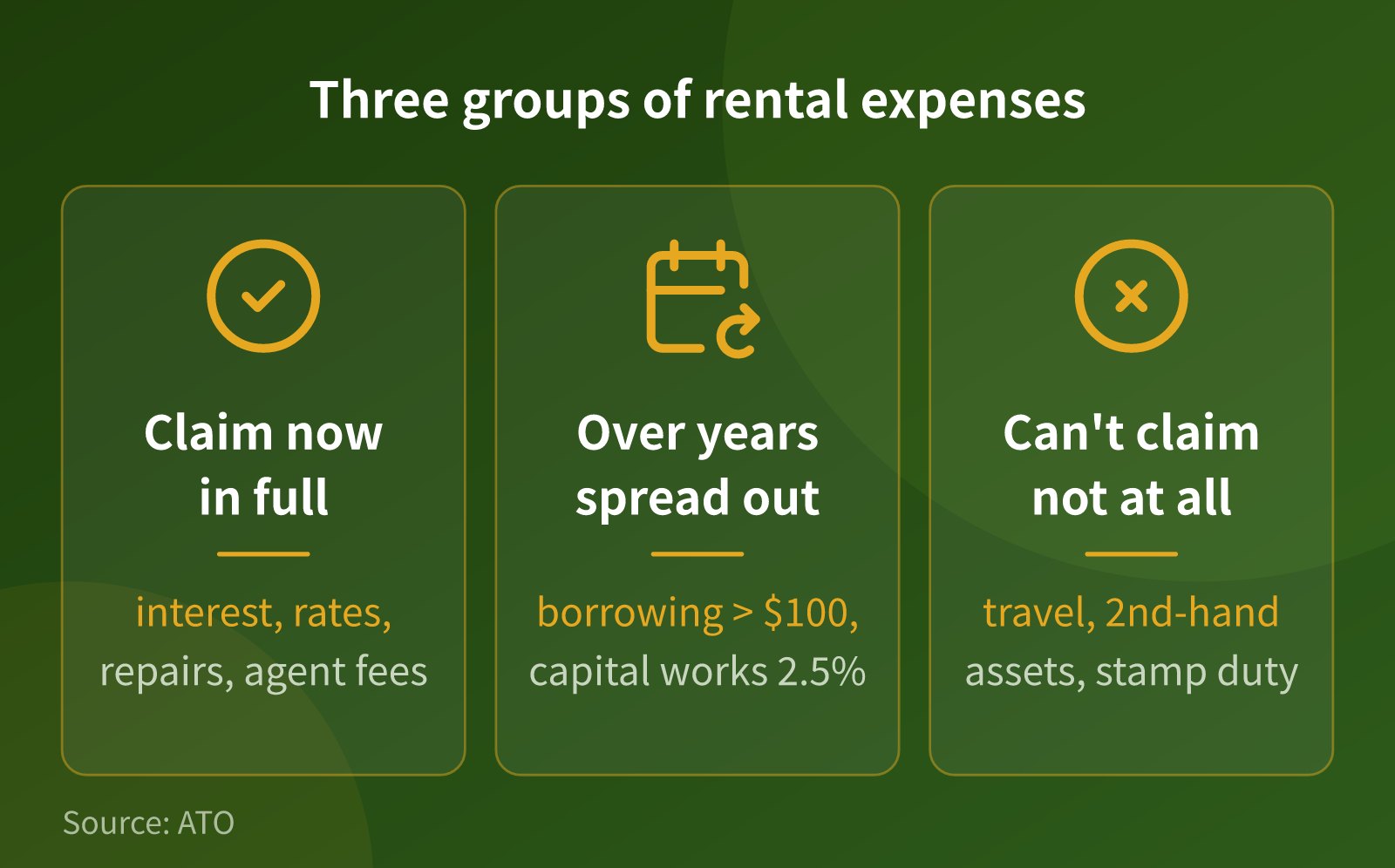
1. Expenses you can claim in full this year
If you paid the expense yourself (not the tenant), and the property was rented or genuinely available for rent at the time, you can generally claim these in the year you incur them:
- Interest on your investment loan
- Council rates, water charges and land tax
- Body corporate administrative fund fees and charges
- Insurance: building, contents, public liability and loss of rent
- Property agent fees and commission, and advertising for tenants
- Repairs and maintenance, such as replacing a cracked window pane or fixing a leaking tap
- Cleaning, gardening, lawn mowing and pest control
- Bank charges, bookkeeping, tax-related expenses and lease document costs
- Assets costing $300 or less (that are not part of a set costing more than $300)
Expenses that relate only to renting out the property, such as advertising and agent commission, are fully deductible and do not need to be apportioned.
2. Expenses you claim over several years
- Borrowing expenses: loan establishment fees, loan valuation fees, mortgage broker fees, lender's mortgage insurance and stamp duty on the mortgage. If they total more than $100, the deduction is spread over 5 years from the day the loan is taken out (or the loan term, if shorter). $100 or less is claimed in full. Stamp duty on the transfer of the property is not a borrowing expense.
- Capital works: for residential buildings whose construction started after 15 September 1987, you can generally claim 2.5% of the construction cost each year for 40 years. Land and landscaping are excluded. A quantity surveyor's report can work this out for an established property, and the surveyor's fee is itself deductible.
- Assets over $300: for example a new hot water system, air conditioner or dishwasher, claimed over its effective life (decline in value).
For residential rentals bought after 7:30 pm on 9 May 2017, the second-hand furniture and appliances that came with the property generally cannot be depreciated. New assets you buy and install yourself still can.
3. Expenses you can't claim (common ATO errors)
- Travel to inspect the property, collect rent or do repairs is generally not deductible for a residential rental, unless you carry on a business of letting properties or are an excluded entity such as a company.
- Initial repairs and improvements: fixing damage that existed when you bought the property, renovating a kitchen or bathroom, extensions and landscaping are capital costs. They are not deductible now, but may form part of your CGT cost base or capital works claims.
- Purchase and sale costs such as transfer stamp duty and conveyancing go into the cost base, not this year's deductions.
- Private use of the loan: if you redraw from the investment loan to buy a car or pay off your home, interest on that part is not deductible and must be apportioned.
- Periods the property was not genuinely available for rent: when you lived there, let family stay free, used it as a holiday home, or asked rent well above the market. If you rent to family or friends below market rent, deductions are generally limited to the rent received.
If the property was rented for only part of the year, or you rented out only part of it, expenses are apportioned by days or floor area.
4. Do the 2026–27 Budget negative gearing changes affect this return?
No. The ATO says the negative gearing changes announced in the 2026–27 Federal Budget don't apply to the 2025–26 tax return. The new rules start on 1 July 2027 — see our negative gearing and CGT checklist for which properties are affected.
5. Own property through a company or trust?
If a company or trust owns the property, or you carry on a business of letting, the travel and second-hand asset rules can apply differently, and how the property is held within the family affects the overall tax result. These cases are best reviewed together with your whole structure.
Checklist before you lodge
- Download your agent's annual rental statement and check income and fees deducted.
- Collect council rates, water, land tax, body corporate and insurance notices.
- Get the bank's annual interest statement; note the purpose of any redraw or offset changes.
- Separate repair invoices from renovation invoices — only repairs are claimed now.
- Check whether borrowing expenses exceed $100 and continue any 5-year spread from earlier years.
- If you don't have one, consider a quantity surveyor's capital works and depreciation report.
- Record dates of private use, vacancy not offered for rent, or family stays for apportionment.
- Keep all records for 5 years from 31 October (or from the date you lodge, if later).
Rental income and expenses are reported in the rental schedule of your individual return. If you have one or more investment properties, our rental property tax return service in Sunnybank can prepare it for you and list every deduction the ATO rules allow.
Frequently asked questions
Can I claim the stamp duty I paid when buying the rental property?
No. Transfer stamp duty is a purchase cost that forms part of the CGT cost base. Stamp duty on the mortgage is a borrowing expense and can be claimed over 5 years if borrowing expenses total more than $100.
Can I claim travel to inspect my rental property?
Generally no, for a residential rental property, unless you carry on a business of letting properties or are an excluded entity.
Can I claim a new kitchen in my rental property?
Not as an immediate deduction. A renovation is an improvement (a capital cost). The construction part may be claimed as capital works over time, and new appliances over their effective life.
How we can help
LYI Accountants is a registered tax agent based in Sunnybank, Brisbane. What you can claim depends on how your property is owned, financed and used, so fill in our online form, or contact us by phone or email, and one of our accountants will prepare your rental schedule correctly.
Sources
- ATO — Rental properties 2026: rental expenses
- ATO — How to claim rental expenses (rental expense categories)
- ATO — Common rental property expenses you can claim
- ATO — Rental properties 2025: rental expenses (capital works rates)
- ATO — Keeping rental property records
This article is general in nature and does not constitute tax or financial advice. Individual circumstances vary — please consult one of our registered tax agents for advice specific to your situation.