
Short answer: yes. If your parents are foreign residents for tax purposes when they sell, they pay Australian capital gains tax (CGT) on the property. Compared with Australian residents, they usually can't use the 50% CGT discount, can't claim the main residence exemption, and are taxed at 30% from the first dollar. Many families only find out when 15% of the price is withheld at settlement.
Step one: are your parents foreign residents?
Tax residency is not the same as a visa or citizenship. The ATO says it doesn't use the Department of Home Affairs rules: a permanent resident or citizen can be a foreign resident for tax purposes, and the reverse is also possible. The ATO looks at factors such as where a person actually lives, their intentions, where their family, work and assets are, and their living arrangements.
A common situation: parents lived in Brisbane for some years, then moved back overseas and kept the property as a rental. By the time they sell, they are quite likely foreign residents. The ATO's residency tests decide it case by case.
Three rules for foreign residents
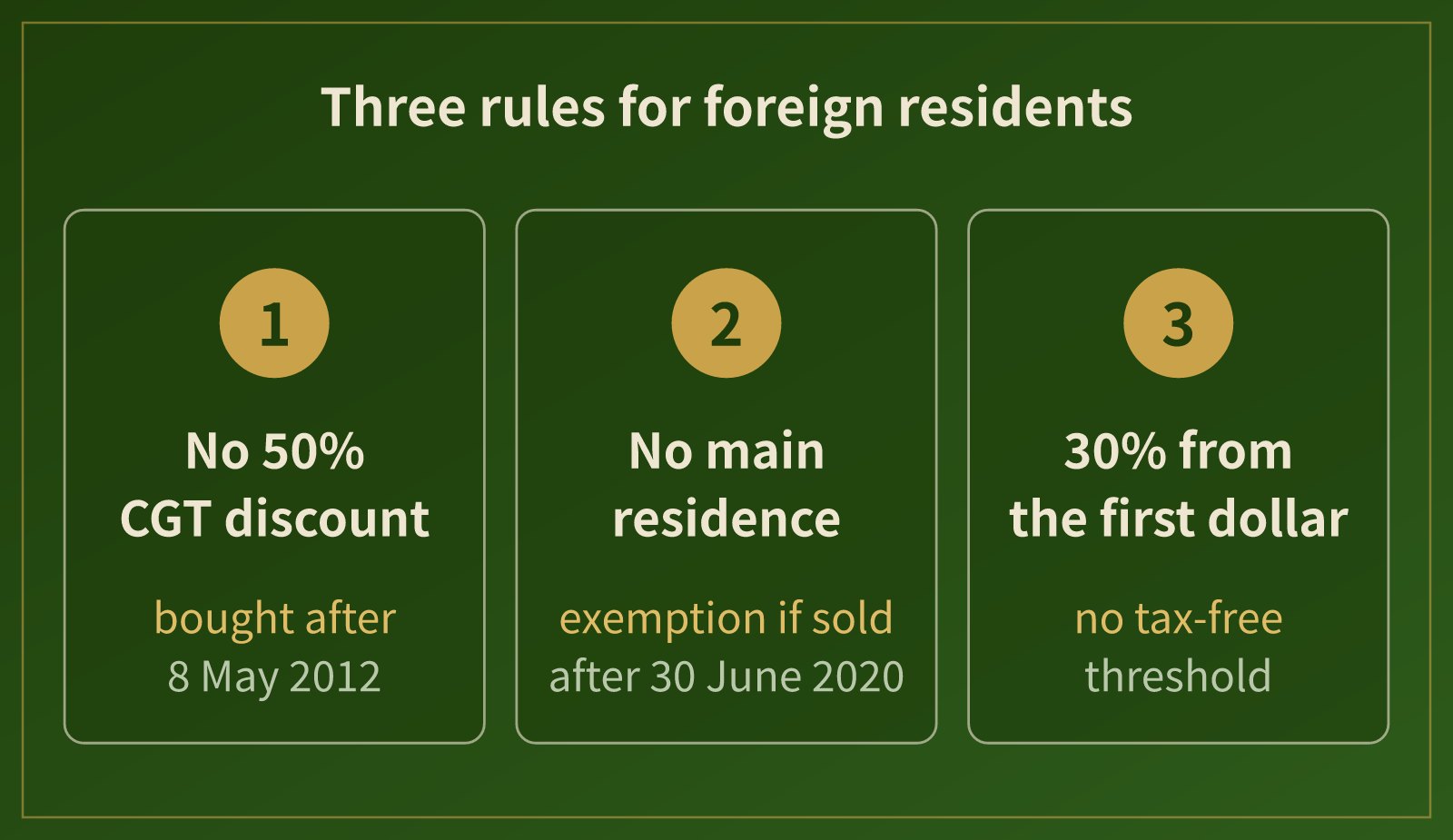
- What's taxed: foreign residents generally pay CGT only on taxable Australian property, which includes real estate in Australia. Their overseas home and shares are outside Australian CGT.
- No full 50% discount: foreign residents aren't entitled to the full 50% CGT discount for assets acquired after 8 May 2012. If they were Australian residents for part of the ownership period, the discount can be apportioned for that time.
- No main residence exemption: foreign residents can't claim the main residence exemption for property sold after 30 June 2020, even if it used to be their home. The only exception is the life events test: foreign resident for a continuous period of 6 years or less, and during that time a terminal medical condition (theirs, their spouse's or a child under 18), the death of a spouse or child under 18, or a sale under a formal agreement after a relationship breakdown.
- No tax-free threshold: 2025–26 foreign resident rates are 30% up to $135,000, 37% from $135,001 to $190,000 and 45% above $190,000. On the plus side, someone who was a foreign resident for the whole year can claim an exemption from the Medicare levy.
A worked example
Take a couple living overseas. In 2015 they bought a unit in Sunnybank as a rental for a total cost of $520,000, including stamp duty and legal fees. In 2026 they sign a contract to sell it for $800,000, paying $20,000 in agent and legal fees. They were foreign residents the whole time and had no other Australian income that year.
- Capital gain: $800,000 − $520,000 − $20,000 = $260,000 (no 50% discount, so all of it is taxed)
- Tax at 2025–26 foreign resident rates: $60,850 + ($260,000 − $190,000) × 45% = $92,350
- Withheld by the buyer at settlement: $800,000 × 15% = $120,000
- After the tax return, the extra $27,650 comes back as a credit
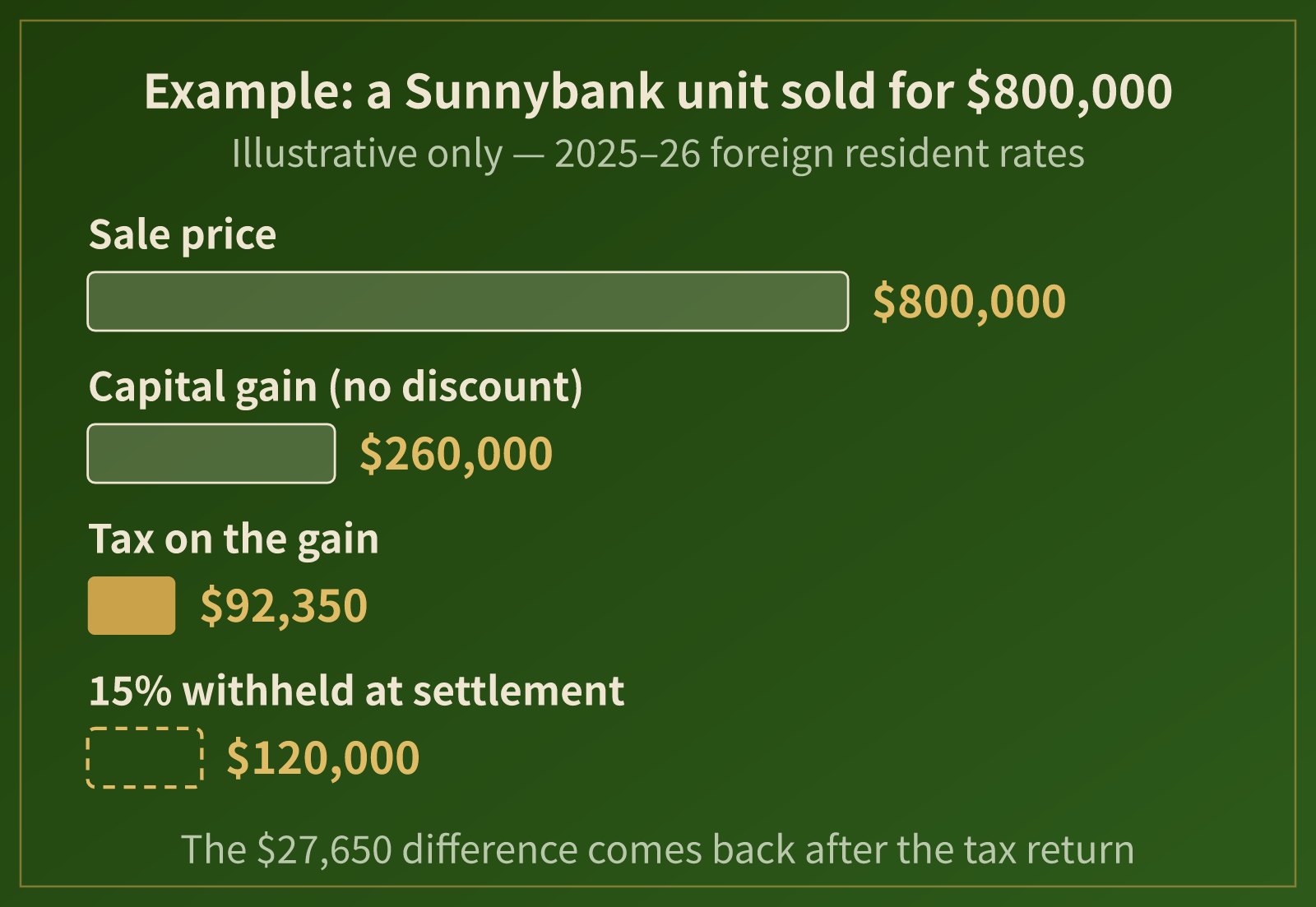
An owner who was an Australian resident the whole time could use the 50% discount, so only $130,000 of the same gain would be taxed, with the tax-free threshold on top. That's why it pays to confirm residency and work out the tax before selling.
The 15% withholding is not the final tax. Without an ATO clearance certificate, the buyer withholds 15% of the price and pays it to the ATO. Your parents still lodge an Australian tax return for the income year in which the contract was signed, report the gain, and claim the withheld amount as a credit. If 15% is clearly more than the tax they will owe, they can apply to the ATO for a variation before settlement.
FAQ
My parents have PR or citizenship. Doesn't that make them residents?
Not necessarily. Tax residency doesn't depend on visa or citizenship; it depends mainly on where they actually live. A permanent resident or citizen who lives overseas long term can be a foreign resident.
The property used to be their home. Is it exempt?
Generally not if they are foreign residents when they sell, unless they pass the life events test above. If they plan to move back and become Australian residents again before selling, the result can be different — that needs advice on their own situation.
How do they lodge if they're overseas?
They lodge an Australian individual tax return for the income year in which the contract was signed, reporting the gain and that year's rental income and claiming the withholding credit. A registered tax agent can do this for them.
Do the 1 July 2027 CGT changes matter?
The CGT changes apply to gains that accrue after 1 July 2027 — see our article on the negative gearing and CGT changes. The ATO hasn't yet said how they apply to foreign residents, so anyone planning to sell after 2027 should check the final rules.
A checklist before selling
- Confirm each owner's residency status for tax purposes at the time of sale.
- Note the purchase date (before or after 8 May 2012) and any years they were Australian residents.
- Gather cost records: purchase contract, stamp duty, legal fees and receipts for capital improvements.
- Estimate the CGT before signing. If 15% is clearly too high, apply for a variation early (the ATO can take up to 28 days).
- After settlement, keep the buyer's FRCGW Payment Confirmation and the settlement statement.
- Lodge the Australian tax return for the year the contract was signed and claim the credit.
How we can help
LYI Accountants is a registered tax agent based in Sunnybank, Brisbane. How much CGT your parents pay depends on their residency history, when they bought and what the property was used for, so fill in our online form, or contact us by phone or email, and one of our accountants will work through the numbers with you before the contract is signed.
Sources
- ATO — Your tax residency
- ATO — Your residency status and CGT
- ATO — CGT discount for foreign residents
- ATO — Main residence exemption for foreign residents
- ATO — Tax rates: foreign residents
- ATO — Foreign resident capital gains withholding overview
- ATO — Foreign residents Medicare levy exemption
This article is general in nature and does not constitute tax or financial advice. Individual circumstances vary — please consult one of our registered tax agents for advice specific to your situation.