Short answer: you must register for GST within 21 days once your GST turnover reaches $75,000 a year ($150,000 for non-profits). Rideshare and taxi drivers must register from the start, whatever they earn. Once registered, you lodge a BAS — monthly, quarterly or (for some small businesses) annually — and most small businesses use the three-label Simpler BAS. This guide is for Brisbane sole traders with an ABN, new companies and family businesses that are not sure whether GST applies to them yet.
Do you need to register for GST?
The ATO looks at your GST turnover — your gross business income, not your profit, and not counting GST itself. You check it two ways, and either one can trigger registration:
- Current GST turnover: this month plus the previous 11 months.
- Projected GST turnover: this month plus the next 11 months — so a new business that expects to pass $75,000 in its first year needs to register now, not after year end.
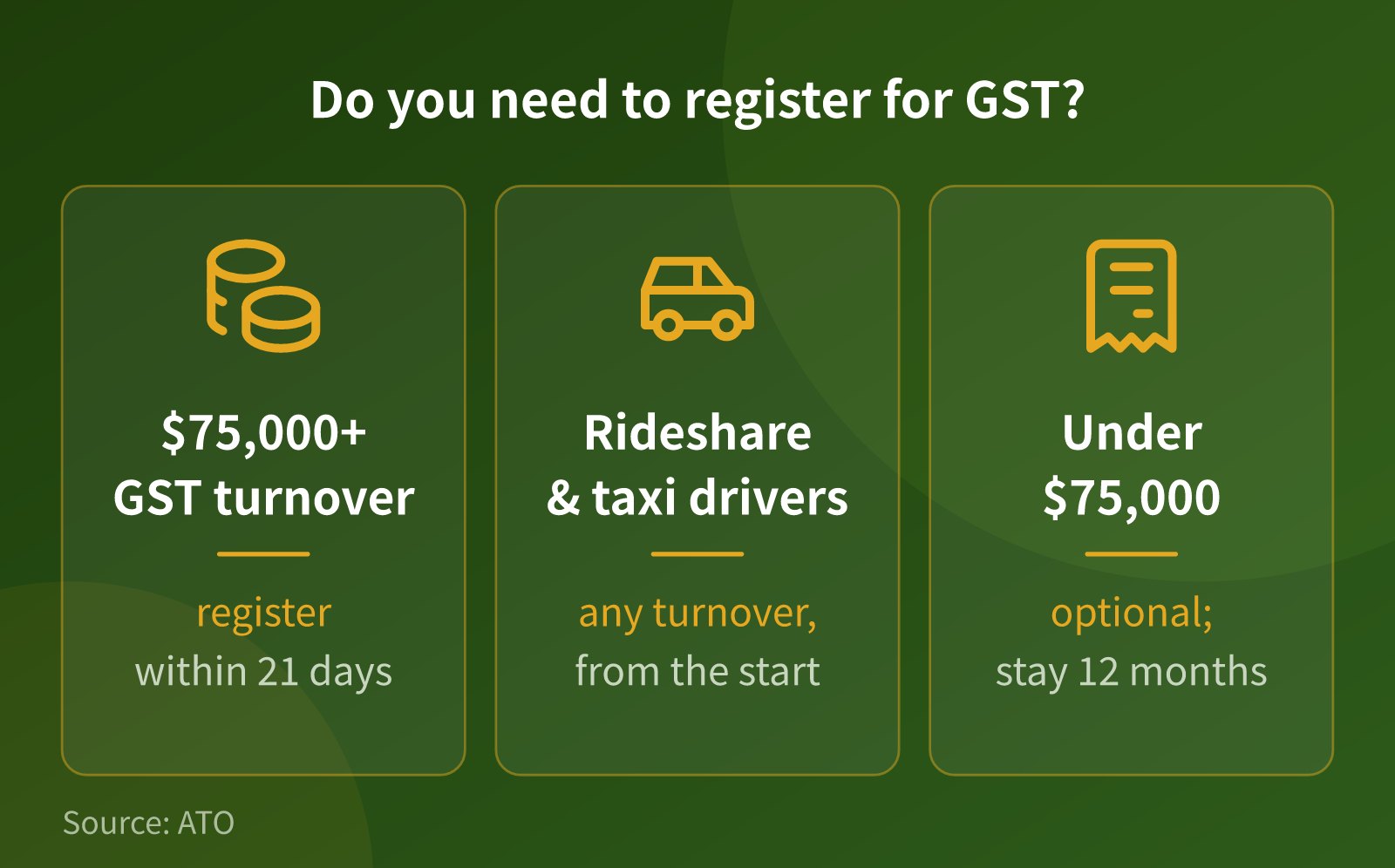
If you are under the threshold, registering is optional. Some businesses register voluntarily so they can claim GST credits on start-up purchases, but the ATO says you generally need to stay registered for at least 12 months, and you then charge GST on your sales. If you should have registered earlier, the ATO can backdate your registration (generally up to 4 years), and GST is then payable on sales you made from that date — even if you did not charge your customers for it.
Key point: GST turnover of $75,000 or more = register within 21 days. Taxi and ride-sourcing drivers (including Uber) must register regardless of turnover.
How often do you lodge a BAS?
Once registered, you report GST on your business activity statement (BAS). How often depends on your size:
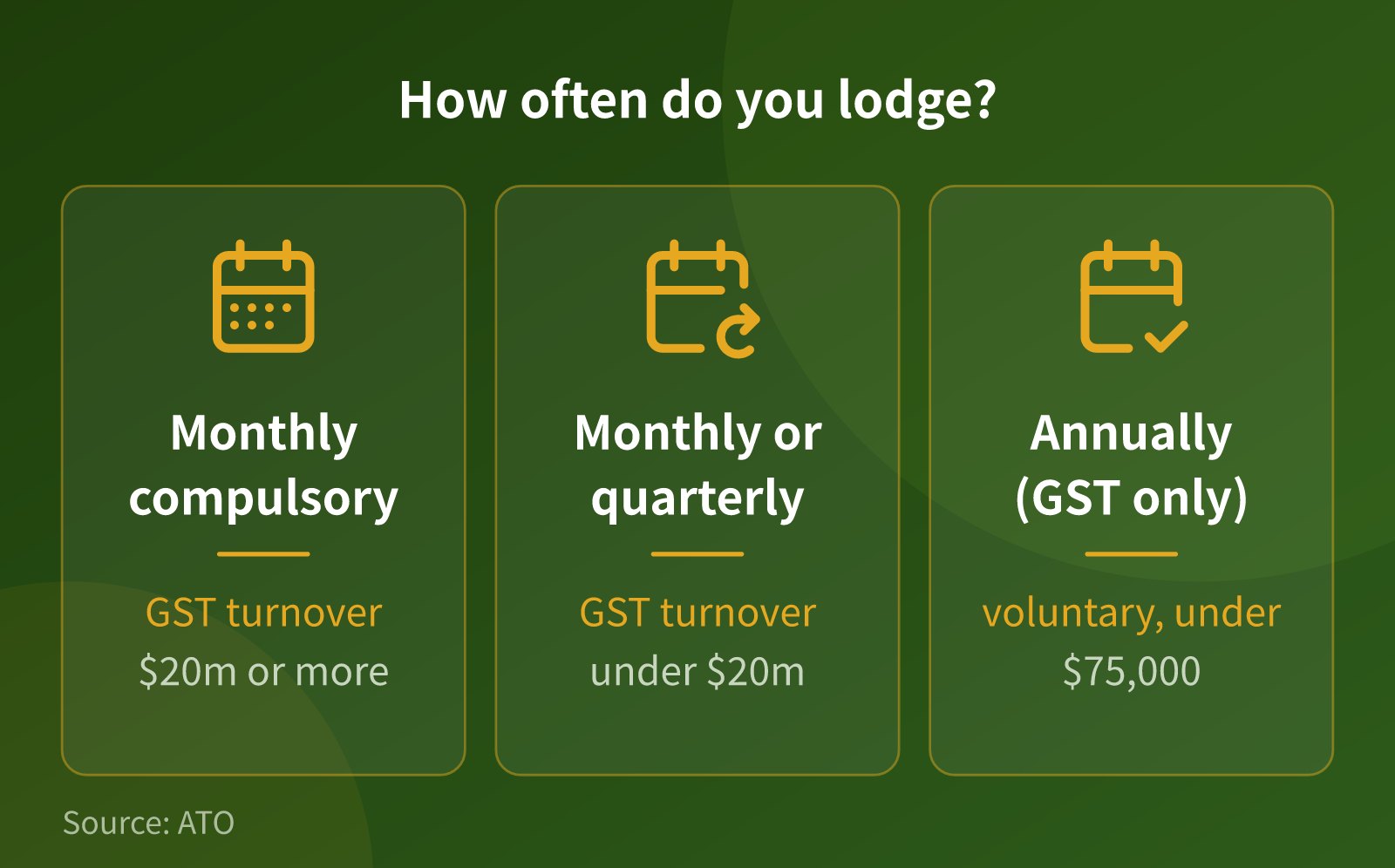
| GST turnover | Reporting cycle |
|---|---|
| $20 million or more | Monthly (compulsory) |
| Under $20 million | Monthly or quarterly — most small businesses report quarterly |
| Under $75,000 and registered voluntarily | Can elect to report GST annually |
Quarterly BAS due dates, and the extra time you get when a registered agent lodges for you, are covered in our post on the Q1 BAS due date.
Simpler BAS, and cash or accrual?
If your GST turnover is under $10 million, you generally use Simpler BAS. You only report three GST labels: G1 total sales, 1A GST on sales and 1B GST on purchases. Businesses with GST turnover of $10 million or more must use full reporting.
You also choose when to count GST. With an aggregated turnover under $10 million, you can use the cash basis (report GST when you are paid and when you pay) or the non-cash (accrual) basis (report a sale when you issue the invoice or receive payment, whichever comes first). Cash basis suits many small businesses because you do not pay GST on invoices your customers have not paid yet.
Common GST mistakes the ATO sees
- Claiming GST credits on private expenses, such as food or entertainment.
- Claiming credits on purchases with no GST in the price — bank fees, stamp duty, GST-free items, or purchases from a supplier who is not registered for GST.
- Claiming the full amount of a purchase that is partly personal (for example a car or phone) instead of the business portion only.
- Counting the same invoice twice, or spreadsheet formula errors.
- Claiming a credit without a tax invoice: you need one for purchases over $82.50 (including GST).
Keep your tax invoices and other GST records for 5 years. If you find a mistake later, many errors can be corrected on a later BAS rather than revising the old one, within the ATO's limits.
Your GST checklist
- Work out your current and projected GST turnover today — not at year end.
- If you are at or near $75,000, or you drive for a rideshare platform, register for GST within 21 days.
- Decide on cash or accrual, and monthly or quarterly reporting, before your first BAS.
- Ask suppliers for a tax invoice on every purchase over $82.50 and keep it for 5 years.
- Separate private and business use before claiming credits on mixed purchases.
- Have a registered agent lodge your BAS so you can use the agent lodgment dates.
For the bigger picture — ABN, company tax, PAYG instalments and super — see our small business tax guide. If you would rather hand GST over, our BAS and GST accountant in Brisbane service covers GST registration, quarterly BAS and your annual company or business tax return.
Frequently asked questions
Do I need to register for GST if I earn under $75,000?
Usually not, unless you provide taxi or ride-sourcing services (such as Uber), which require GST registration regardless of turnover. You can register voluntarily, but you generally need to stay registered for at least 12 months.
Is the $75,000 based on profit or income?
Income. GST turnover is your gross business income (excluding GST), not your profit. Check both your current (last 12 months) and projected (next 12 months) turnover.
Can I lodge my GST once a year?
Only if you are registered for GST voluntarily with GST turnover under $75,000 ($150,000 for non-profits). Otherwise you report monthly or quarterly.
How we can help
LYI Accountants is a registered tax agent based in Sunnybank, Brisbane. Whether you need GST, and which reporting options suit you, depends on your business, so fill in our online form, or contact us by phone or email, and one of our accountants will help you register and lodge your BAS correctly.
Sources
- ATO — Registering for GST
- ATO — Monthly GST reporting
- ATO — Annual GST reporting
- ATO — GST reporting methods (Simpler BAS)
- ATO — Choosing an accounting method for GST
- ATO — BAS and GST tips
This article is general in nature and does not constitute tax or financial advice. Individual circumstances vary — please consult one of our registered tax agents for advice specific to your situation.