
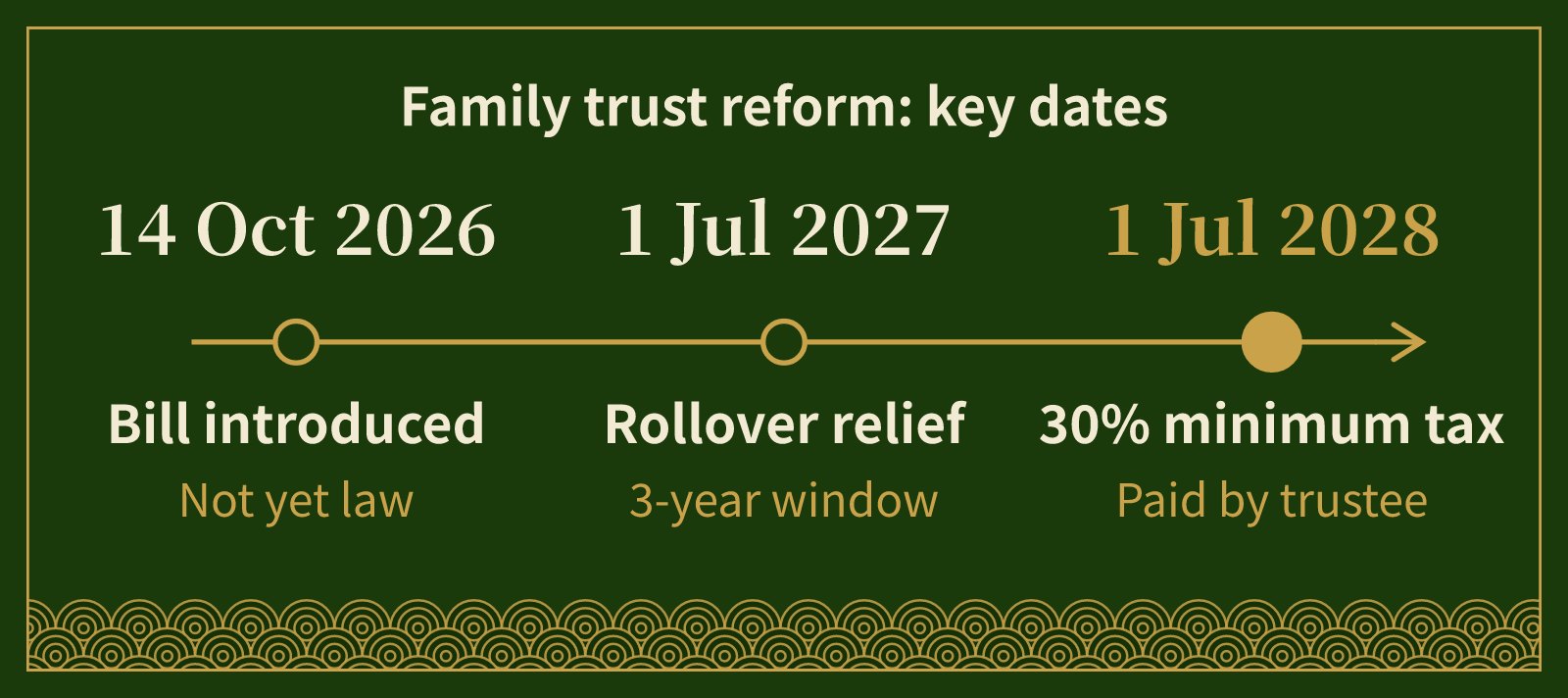
On 14 October 2026 the Government introduced legislation into Parliament for a 30% minimum tax on discretionary trusts (often called family trusts), starting on 1 July 2028. The measure was announced in the 2026–27 Federal Budget on 12 May 2026. It is not yet law, but many Brisbane families and small business owners hold investment property, shares or a business through a family trust, so it is worth understanding what is proposed now.
What is proposed
- From 1 July 2028 (the 2028–29 income year), the trustee pays a minimum tax of 30% on the trust's taxable income.
- Non-corporate beneficiaries who are presently entitled to a share of the trust's net income can claim a tax credit for the tax the trustee paid on that income.
- According to the ATO, the credit is non-refundable.
Why "non-refundable" matters: today, trust income is often distributed to family members on lower tax rates. Under the proposal, that income would bear at least 30% at the trust level, and if a beneficiary's own tax on their share is less than the credit, the difference is not refunded.
Who is not affected
The Government says more than 95% of individual taxfilers receive no trust income, and more than 90% of small businesses will not be affected in any given year. Under the bills, the minimum tax does not apply to:
- fixed trusts, charitable trusts, special disability trusts and superannuation funds (the bills include a new definition of a fixed trust);
- primary production income, and certain income for vulnerable minors;
- deceased estates, and discretionary testamentary trusts set up for genuine testamentary purposes;
- distributions to registered charities and deductible gift recipients (DGRs), and distributions to other tax-exempt entities such as sporting clubs, up to a reasonable cap.
Three paths for an existing family trust
The bills give trusts that would otherwise be caught some options:
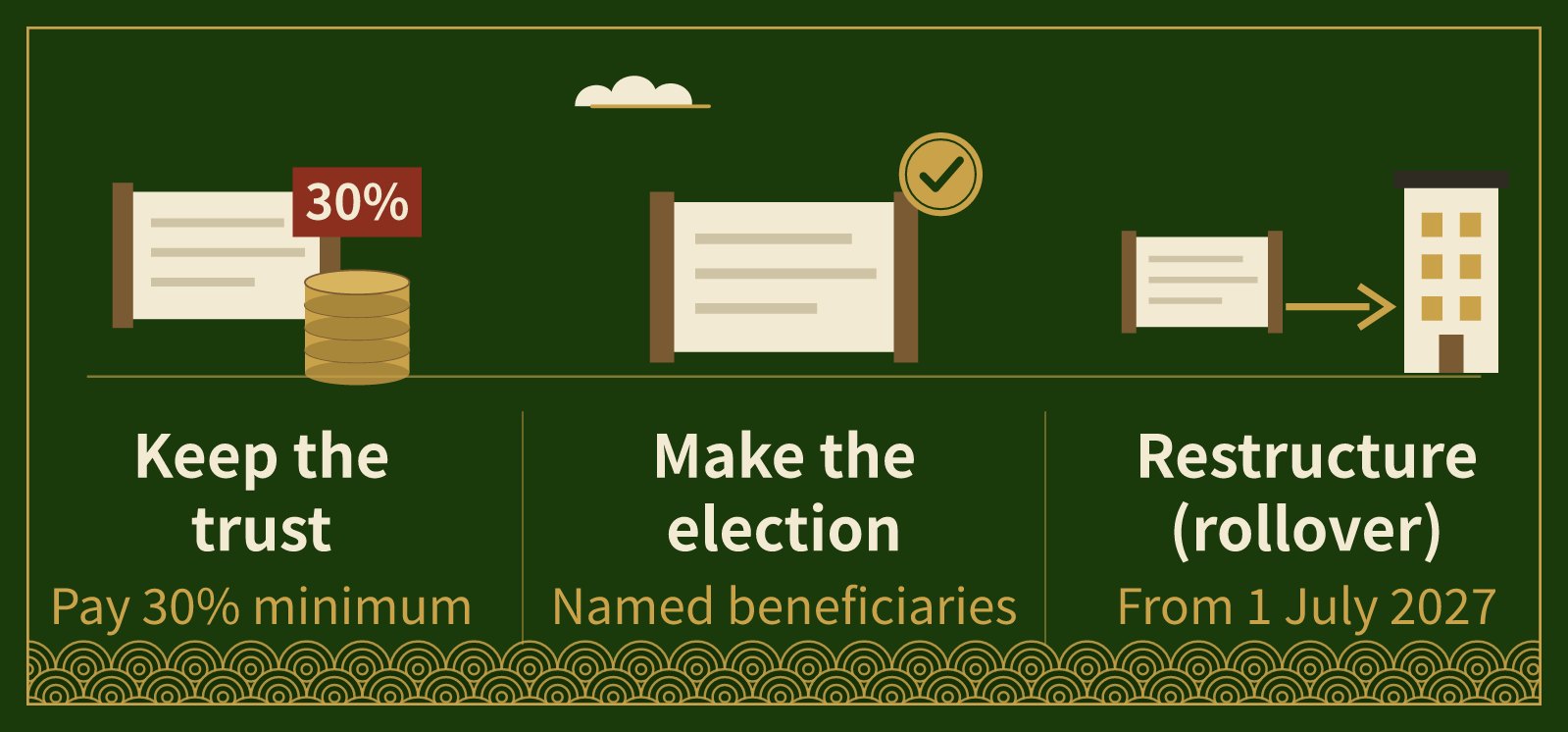
- Keep the trust and pay the minimum tax from 2028–29.
- Make an election. A trust can elect to be exempt from the minimum tax while it continues to distribute income to beneficiaries it nominates up front. The Government says this does not require a restructure, does not limit the trustee's discretionary powers, and is not expected to incur state and territory stamp duties.
- Restructure. Rollover relief is proposed to be available from 1 July 2027 for a limited period of three years, to help move assets out of a discretionary trust into an entity such as a company or fixed trust at a lower restructuring cost.
How it links to the CGT changes
The same bills also clarify how the capital gains tax reforms that start on 1 July 2027 apply in more complex cases, including some trust structures. If your trust holds an investment property, read our earlier article on the negative gearing and CGT changes together with this one.
Not law yet
The bills must still pass both Houses of Parliament, and the details may change. The Government has said it will continue to consult on further tranches of legislation and instruments. Avoid irreversible decisions, such as selling assets or winding up a trust, until the final rules are known.
Checklist before 1 July 2027

- Find your trust deed and confirm what type of trust you have: discretionary, unit/fixed or testamentary.
- List who has received distributions over the last few years, so you can see how a 30% floor could change your family's overall tax.
- Check whether any of the trust's income may be excluded, such as primary production income or distributions to registered charities.
- If your will sets up a testamentary trust, ask your lawyer whether it would meet the "genuine testamentary purposes" exclusion.
- Compare the three paths (keep, elect, restructure) with your accountant, looking at CGT, stamp duty and ongoing costs, not just income tax. The proposed rollover window opens on 1 July 2027.
- Follow the bills' progress and confirm the final rules before acting.
How we can help
LYI Accountants is a registered tax agent based in Sunnybank, Brisbane. Whether a family trust should be kept, elect or restructure depends on your own circumstances, so fill in our online form, or contact us by phone or email, and one of our accountants will go through your situation with you.
Sources
- Treasury — Tax reform for a fairer tax system (media release, 14 October 2026)
- Treasury — Second reading speech, Treasury Laws Amendment (Tax Reform No. 3) Bill 2026
- ATO — Tax reform: introducing a minimum tax on discretionary trusts
This article is general in nature and does not constitute tax or financial advice. Individual circumstances vary — please consult one of our registered tax agents for advice specific to your situation.